
Xi’an History: Four Places That Tell the Story
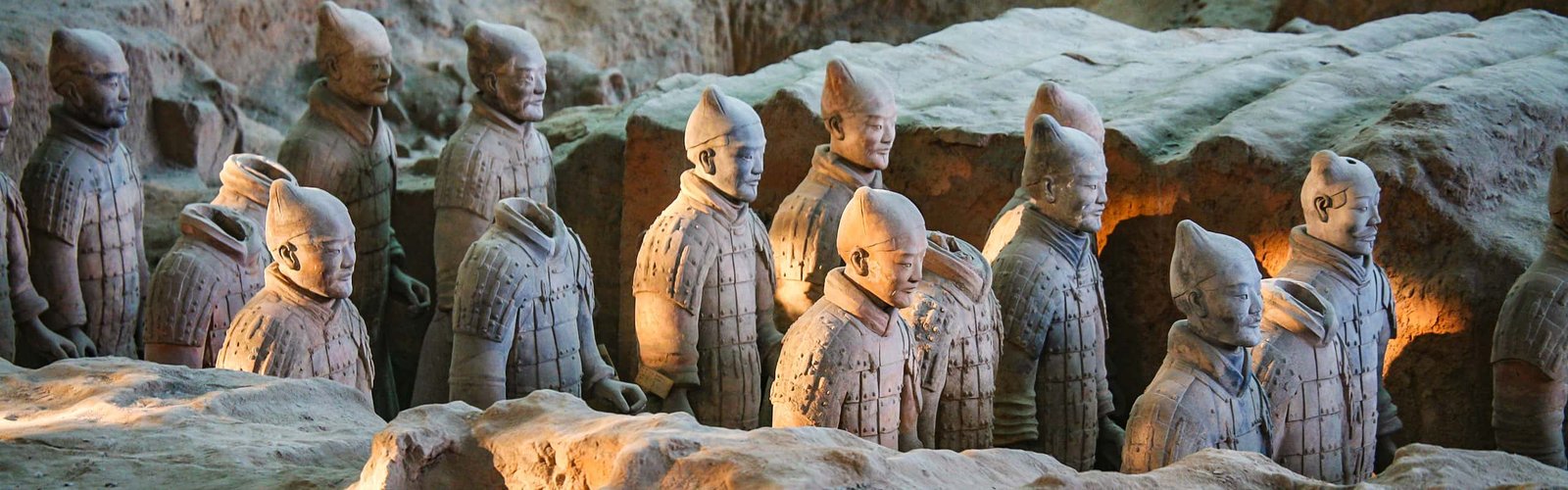
See Xi’an’s history through the Qin Terracotta Army, Shaanxi History Museum, Big Wild Goose Pagoda and City Wall.
These places cover different periods, so visit them as a sequence rather than treating them as one ancient site.
At a glance
- Qin: Terracotta Army at the First Emperor’s mausoleum complex in Lintong.
- Dynastic objects: Shaanxi History Museum in the modern city.
- Tang: Big Wild Goose Pagoda and Buddhist learning.
- Ming: The visible Xi’an City Wall.
Where does the story begin?
Start with the Terracotta Army to understand the Qin imperial project. The pits are in Lintong, away from central Xi’an.
Allow a separate outing for the site. The soldiers differ in details, but the pits also show how a vast burial project was organized.
What can the museum add?
Shaanxi History Museum brings objects from several eras into one visit. Use the gallery labels to link pottery, metalwork and sculpture to their periods.
Choose a few objects to study instead of trying to read every case. A focused visit makes the later city stops easier to understand.
Why visit the pagoda?
Big Wild Goose Pagoda is tied to Tang-era Buddhist learning and the monk Xuanzang. It adds religion and exchange to the story of the capital.
Look at the surrounding precinct as well as the tower. Entry and access to separate spaces can have different rules.
What does the City Wall show?
The wall visitors walk today belongs to the Ming period, later than the Qin and Tang sites. Its gates reveal the shape of the walled center.
Walk one section rather than treating the entire circuit as required. The first-visit itinerary pairs it with nearby central sights.
Which shortcuts confuse the timeline?
Do not call every old structure “Tang.” The visible City Wall and the Terracotta Army belong to different periods.
Do not assume museum objects were found at the site you visit next. Read the object label for its findspot and period.
FAQ: What else should you know?
Was Xi’an once called Chang’an?
Yes, Chang’an is the historic name associated with major imperial capitals. The modern city has changed greatly since those periods.
Is the City Wall from the Qin dynasty?
No. The wall seen by most visitors is Ming-period work. The Terracotta Army is the Qin stop in this route.
Can I fit all four places into one day?
That would be a tiring plan because Lintong is separate. Use at least two days for the four stops.